OCS Contributions
Recent Crossover Review: https://github.com/illuminati1618/pages-databaseguys-sprint4/issues/68#issue-3848734551
-
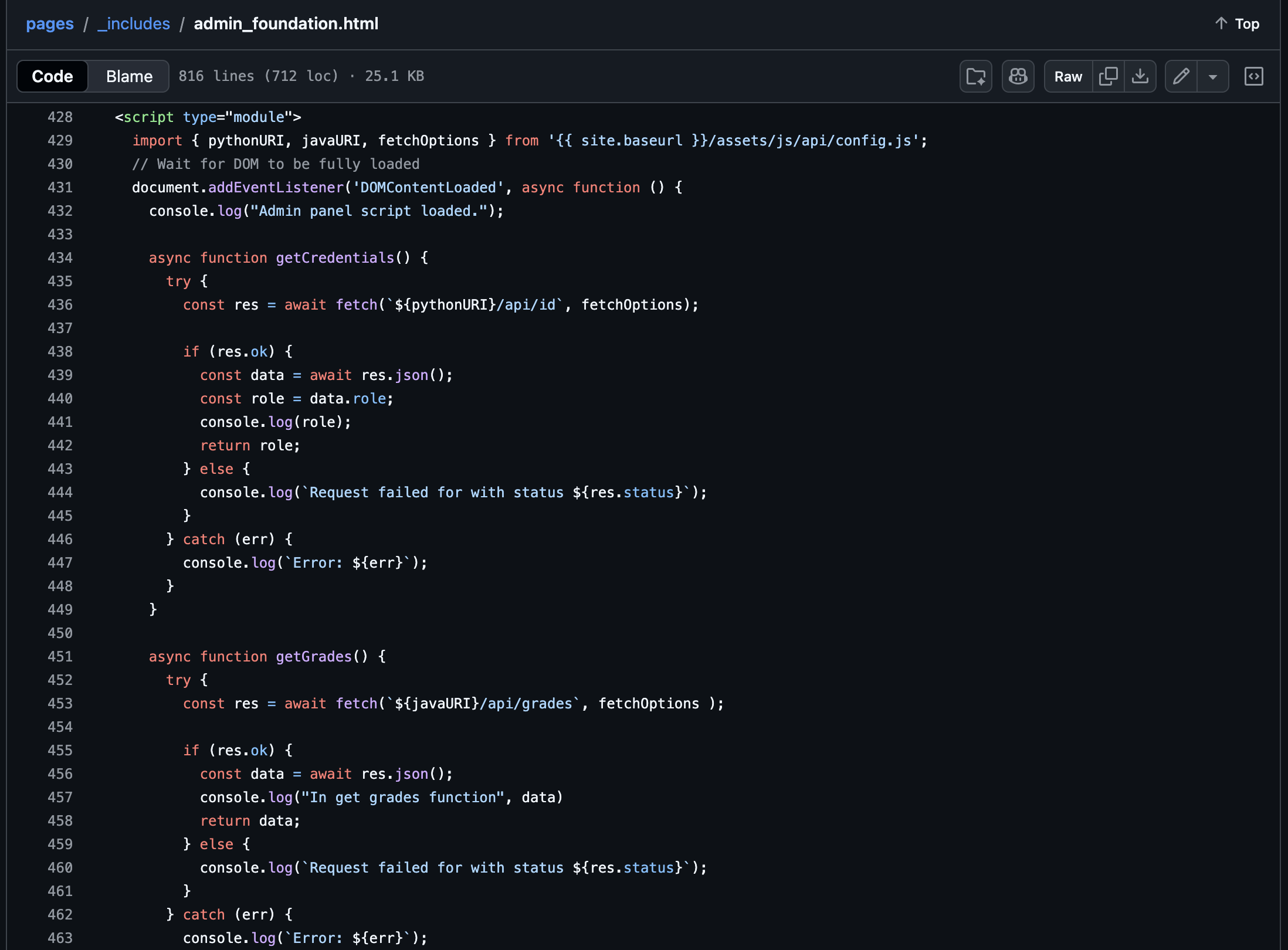
Admin Table (Grade API Complete Refactor and Overhaul) I led a major refactor of the Grade API and rebuilt the admin table to be more scalable, secure, and actually usable long-term. This included adding in-table PDF viewing, PNG viewing with in-window download support, filtering and sorting tools, and stronger admin authentication/security checks. The system is now stable enough that other teams are actively building on top of it (rubrics, aggregation, lesson integration, etc.). More importantly, this work laid the foundation for grade aggregation across lessons and homework, making it a core backend + frontend component of OCS rather than a one-off admin tool.
Impact • Enabled reliable grade aggregation across lessons and homework
• Reduced admin friction through better filtering, previews, and usability
• Improved security and data integrity for sensitive grading workflows
• Created a stable foundation other teams can safely build on
-
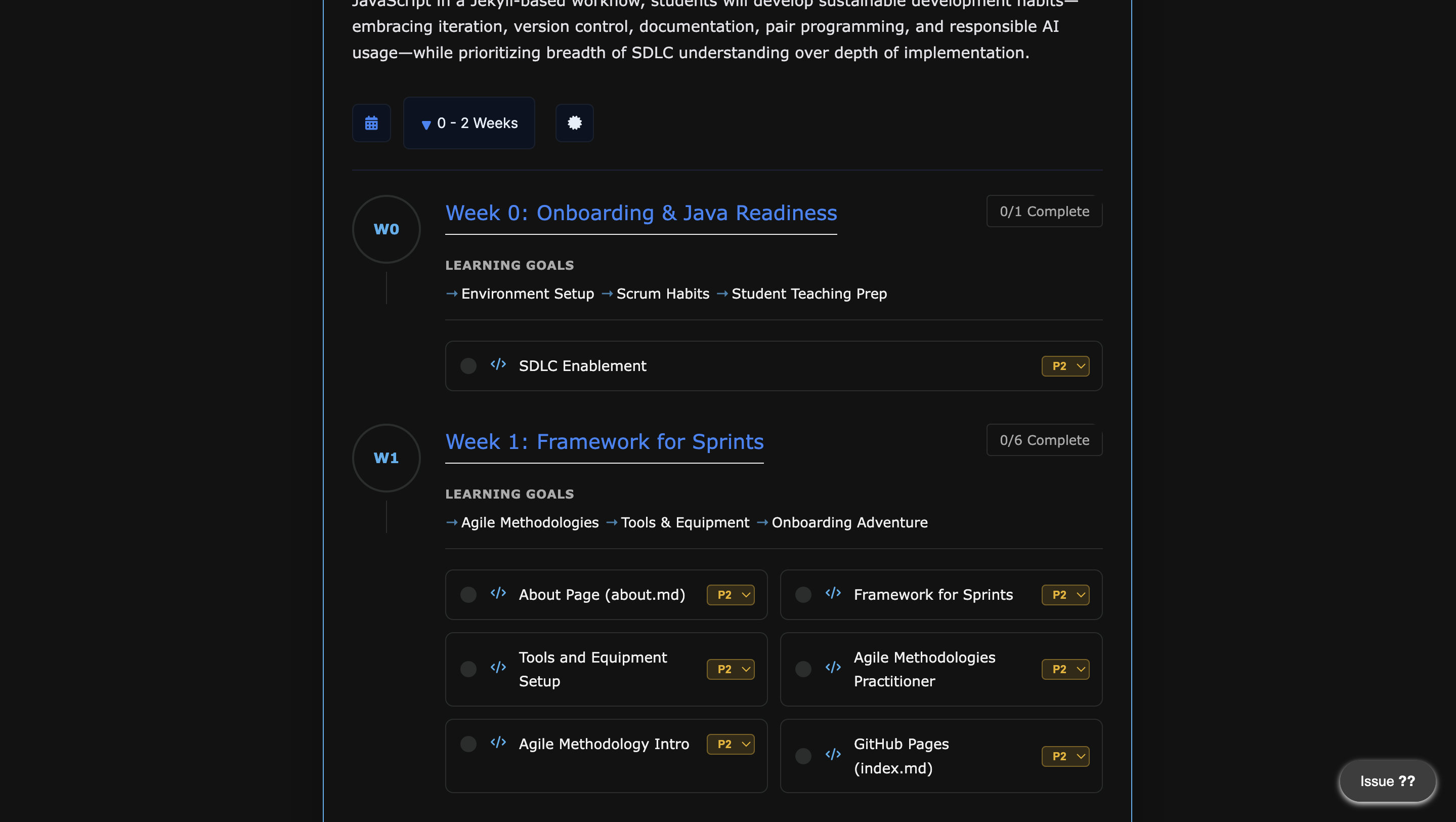
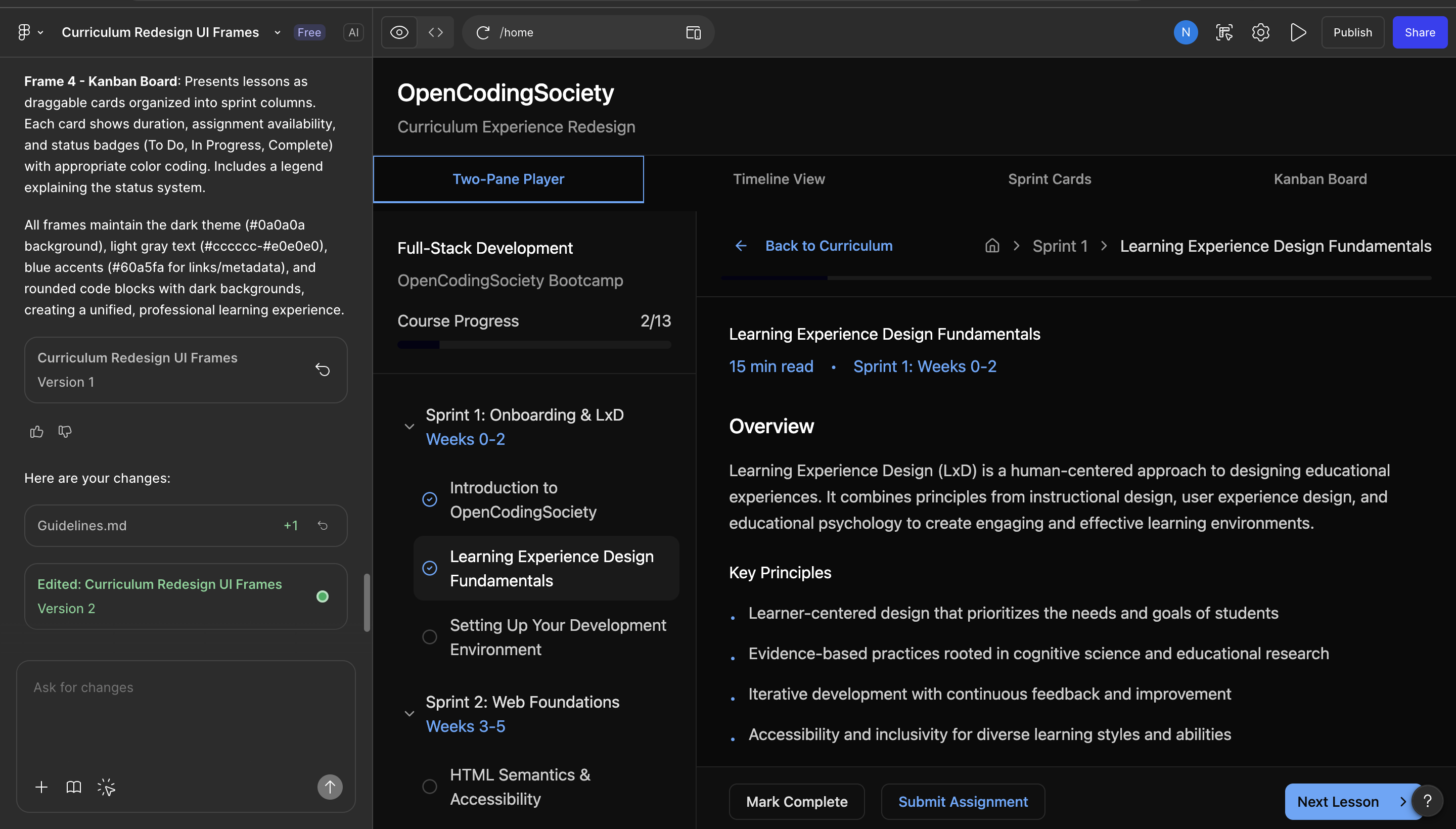
Layout System / Learning Experience Design (LxD) I helped design and implement the new OCS layout system as part of the platform redesign. The course view, including the two-pane layout, was built intentionally using learning experience design principles (such as Merrill’s principles) rather than just visual preference. This structure is now the backbone of how students actually interact with courses on OCS. In addition to design work, I also contributed to smaller but important programming pieces that made the layout functional and reusable. Overall, this became a foundational system that future OCS courses are built on.
Impact • Improved student focus and content flow through intentional layout structure
• Standardized course experiences across the platform
• Made future course development faster and more consistent
• Aligned UI decisions with proven learning science principles
-
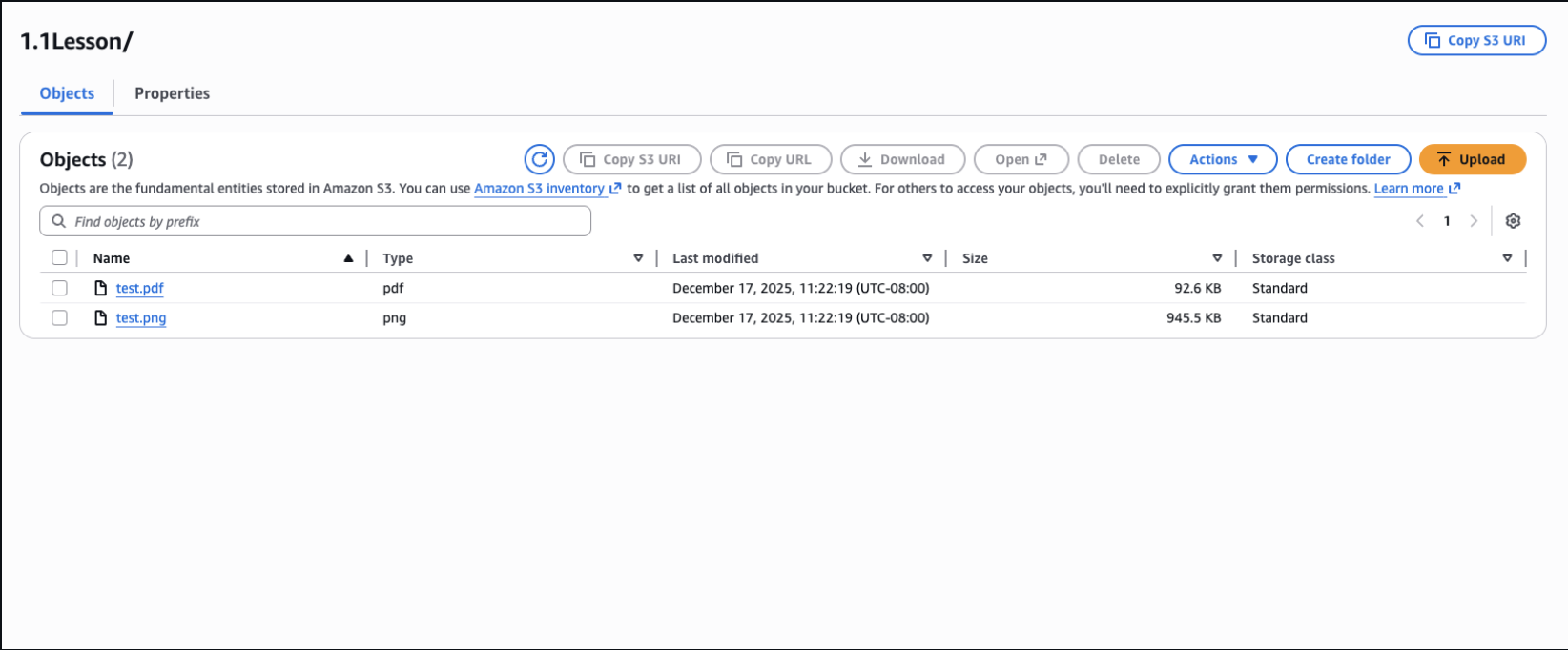
File Upload System (Cross-Platform, Multi-Iteration) I built and iterated on the file upload system multiple times (around 4–5 major iterations), focusing on flexibility and future reuse. This included creating a v1 file upload system in Flask that later students can directly reuse in their own APIs, as well as multiple Spring Boot implementations backed by both local storage and S3. I eventually generalized this into a broader Spring S3 API meant for long-term use across OCS. This work is foundational for future data capture, personalization, and analytics, especially as OCS expands toward more student-specific insights and features discussed by Mort.
Impact • Enabled scalable and consistent file handling across services
• Reduced duplicated effort for future teams needing upload functionality
• Laid groundwork for richer data capture and personalization
• Improved long-term maintainability and infrastructure flexibility
-
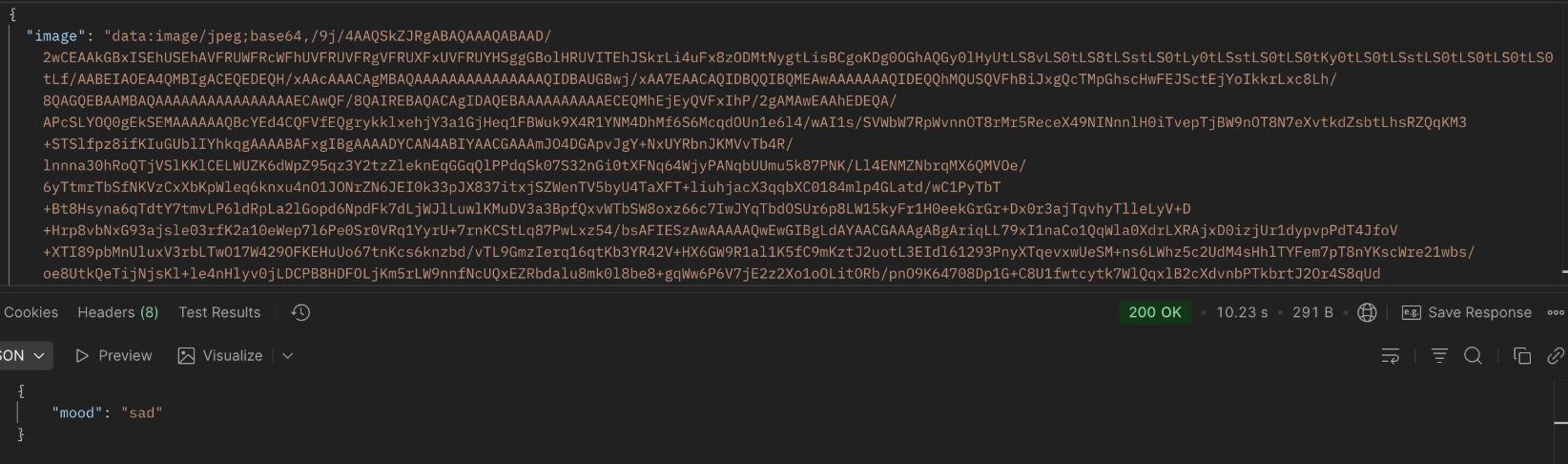
Emotion API (Cross-Class Collaboration Project) I created a secure Emotion API as a passion project that built on ideas originally explored by CSP students. After talking with Nithika and reviewing their work, I designed and implemented the backend AI system to support emotion detection in a clean, secure way. The API is documented separately and can now be used for group features, interactive projects, or future experiments on OCS. This project is a good example of cross-class collaboration, where earlier student work inspired a more advanced, production-ready backend system. Test endpoint created on frontend as well at /facial-login endpoint.
Impact • Enabled experimentation with affect-aware and adaptive features
• Turned exploratory student ideas into a production-ready system
• Encouraged collaboration across experience levels and classes
• Expanded the technical scope of what OCS can support
-
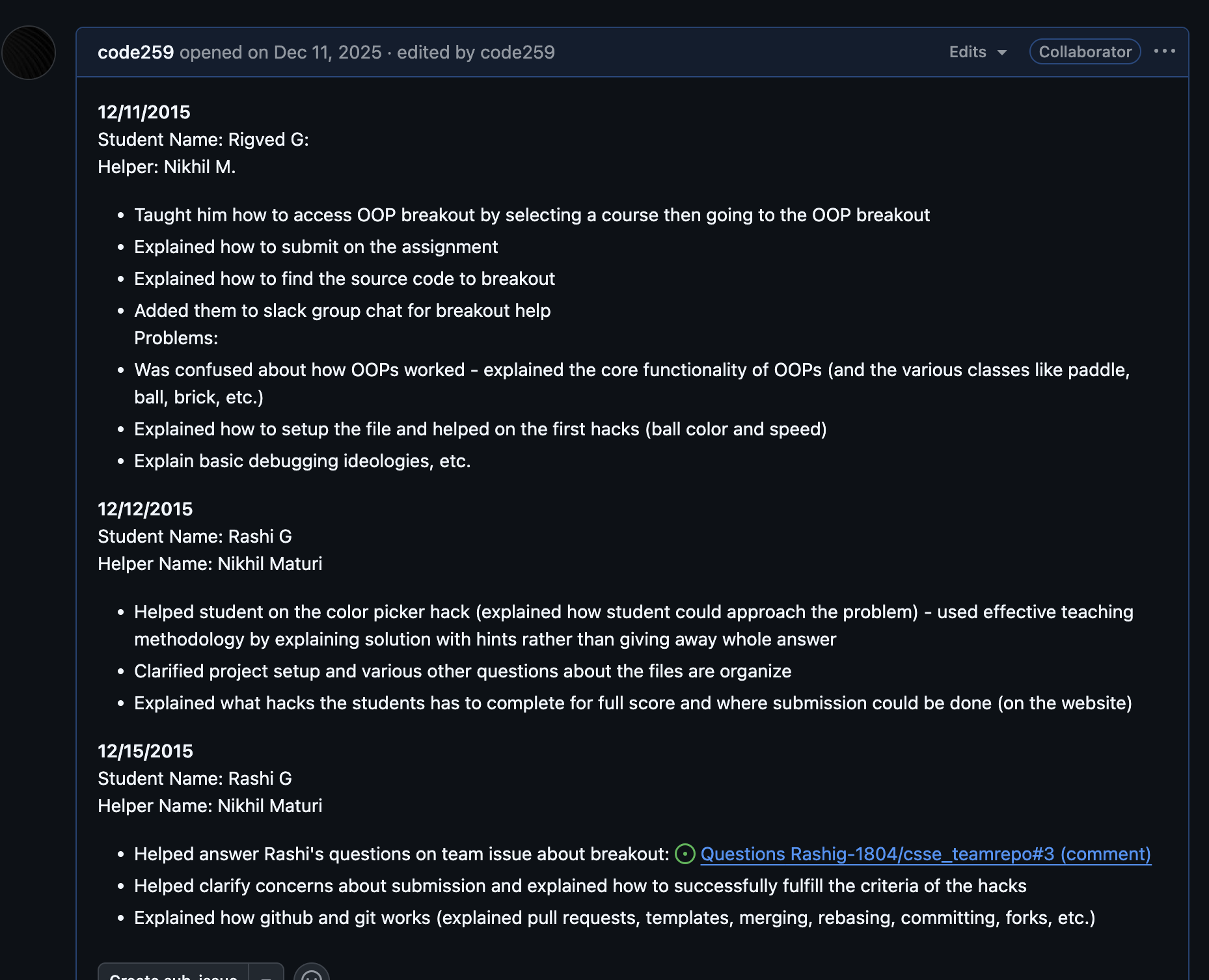
Teamwork and Helping the Community Beyond core engineering work, I consistently helped other students and teams by building lessons and games for younger students, assisting during office hours, and unblocking teammates when they were stuck. I focused on making concepts more understandable rather than just giving answers, which helped others move faster and build confidence. This support work made team collaboration smoother and contributed to a stronger overall learning environment.
Impact • Improved team velocity by reducing blockers and confusion
• Increased knowledge sharing and overall technical confidence
• Strengthened collaboration and team culture
• Helped create a more supportive and effective learning community
Analytics
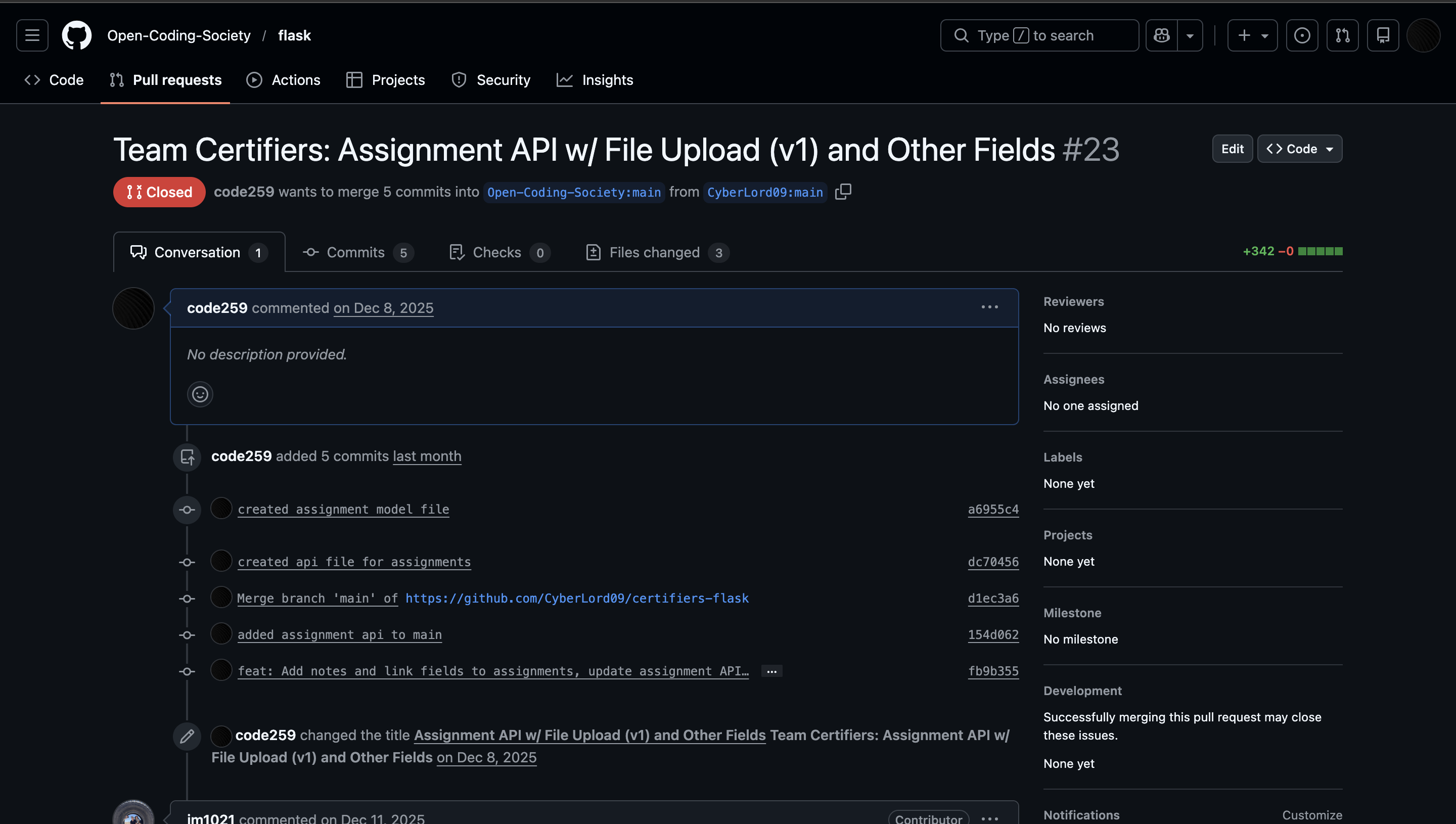
Pull Requests
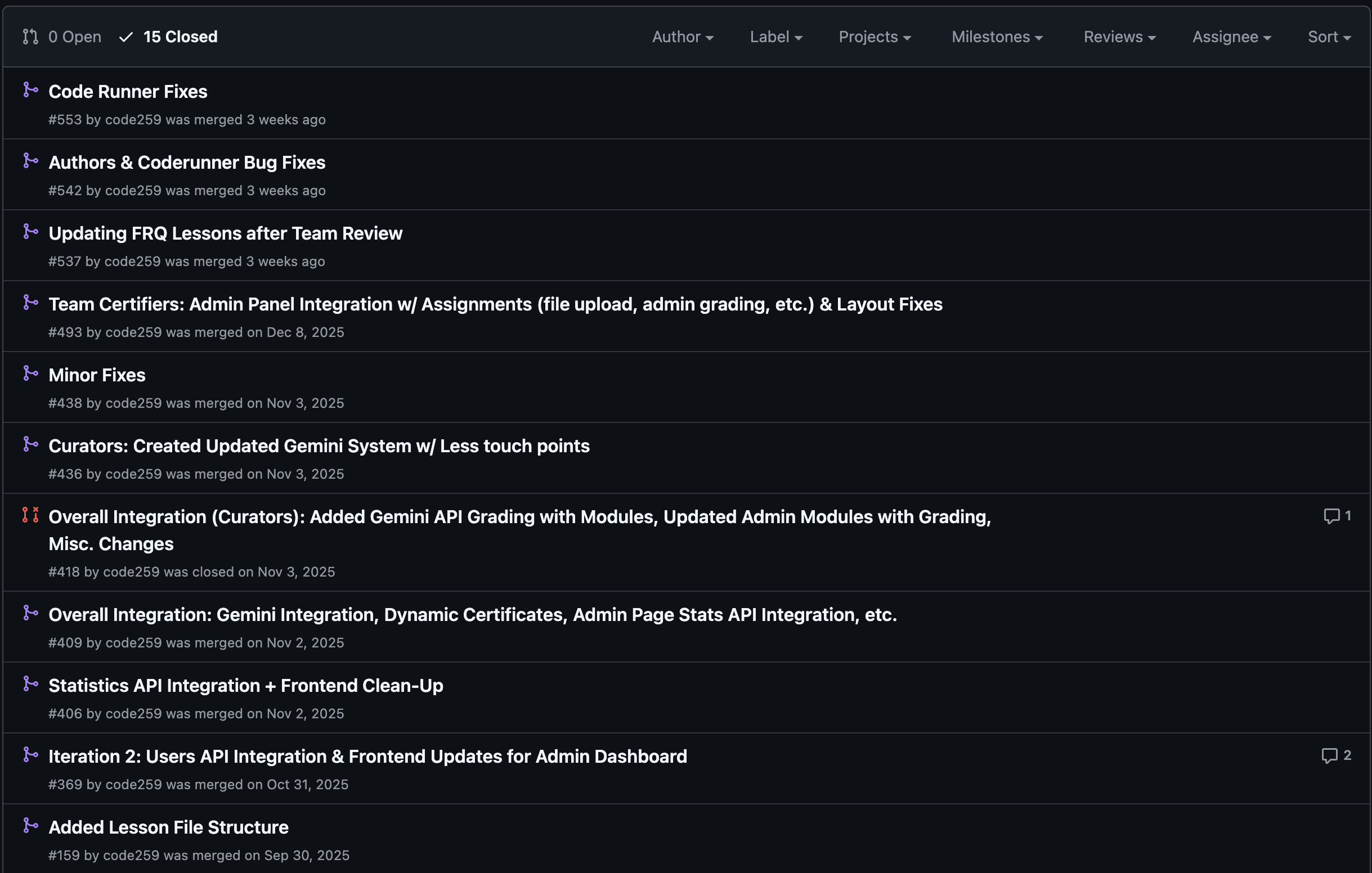
15 pull requests from my account which doesn’t even include commits/work on PRs that Anvay/Yash have made
Most pull requests on spring from Anvay’s account so classified under his name
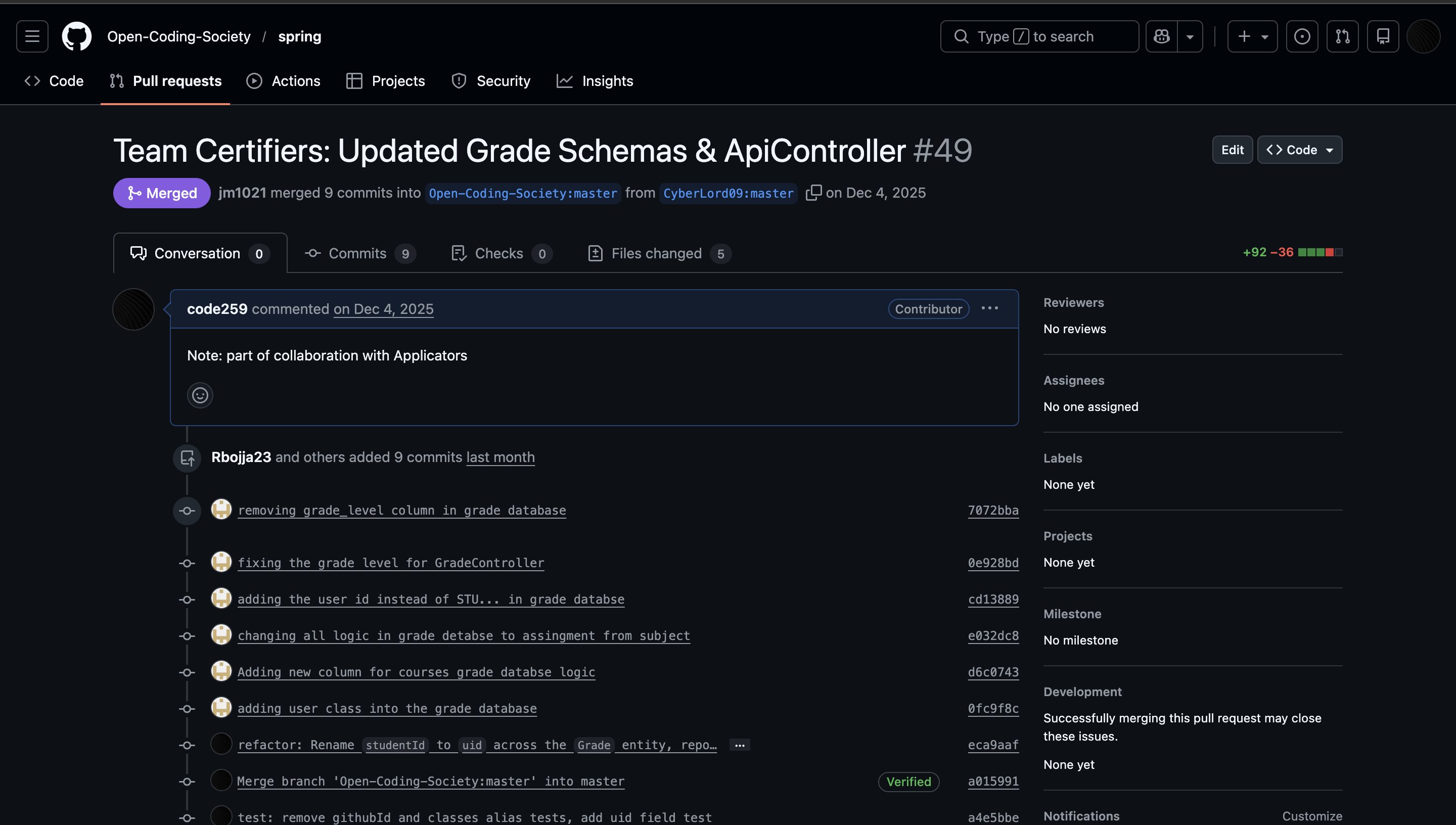
Making pull requests across all repositories and all levels (directly to main OCS repository & to teammates for collaboration)
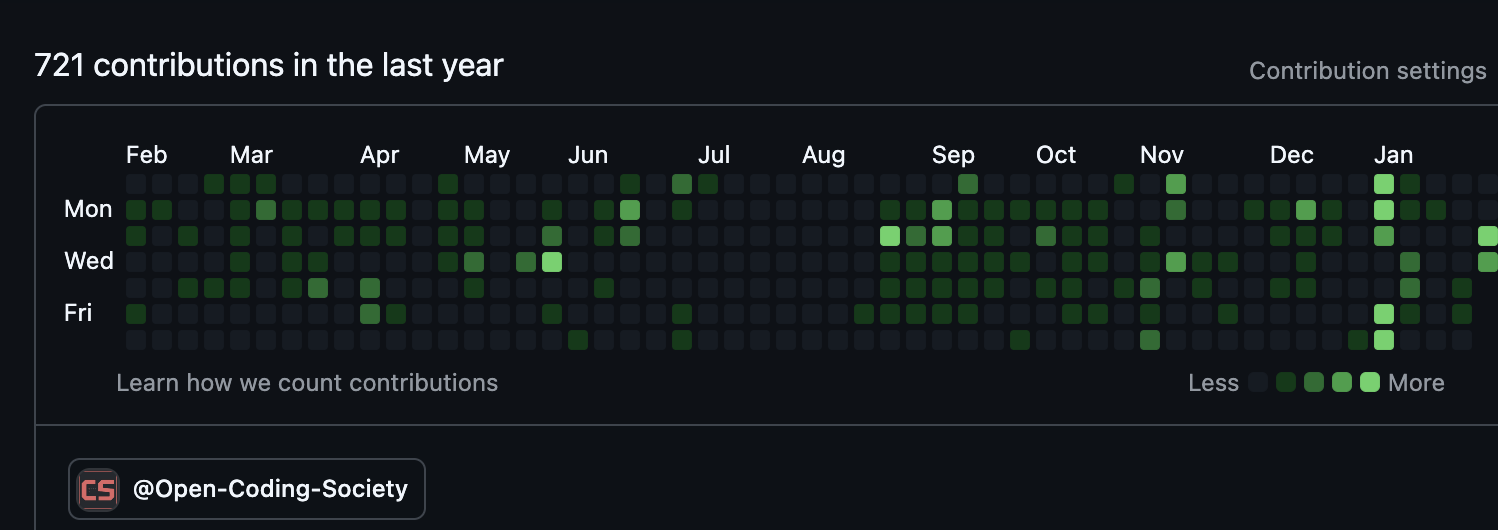
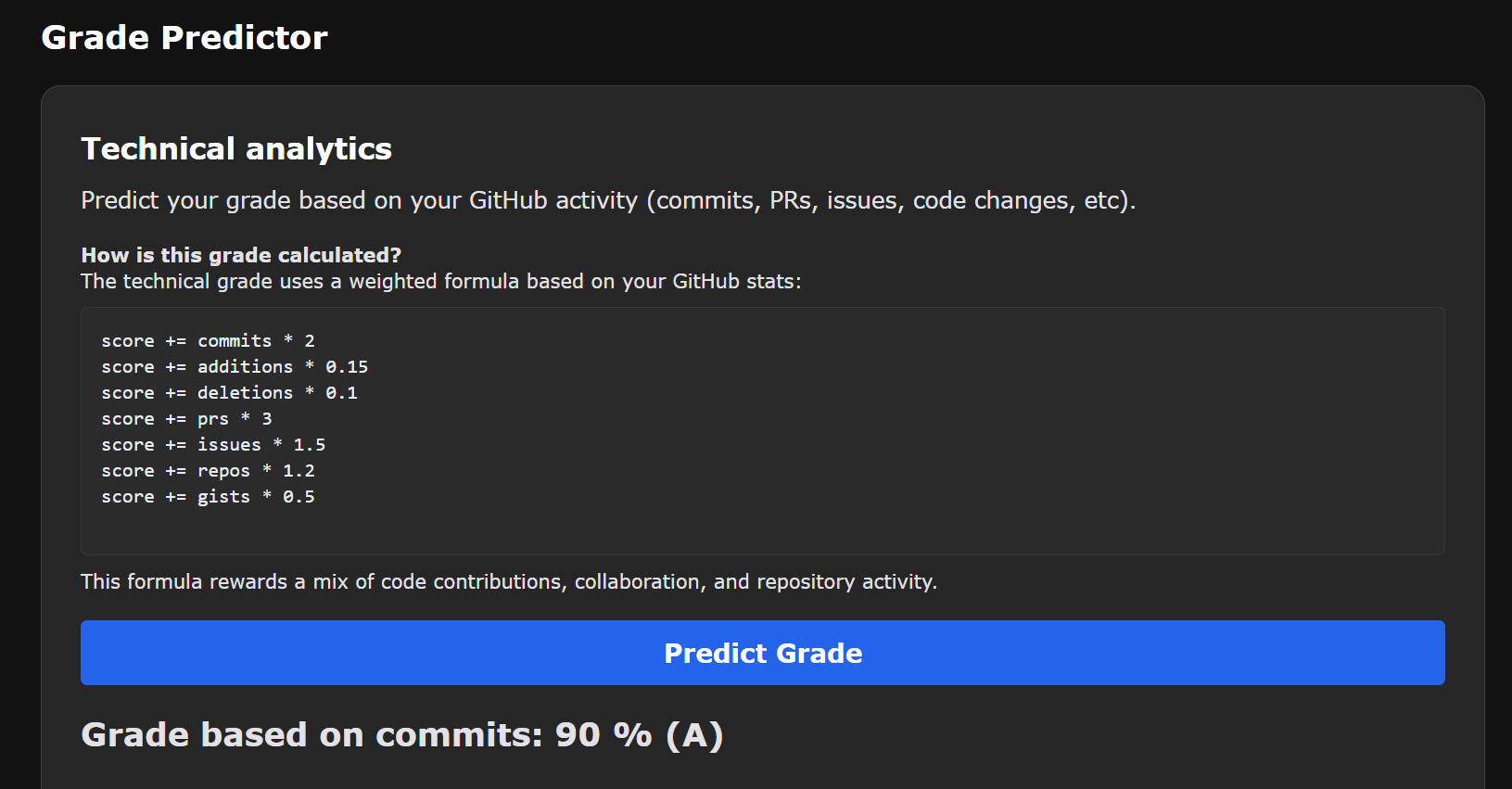
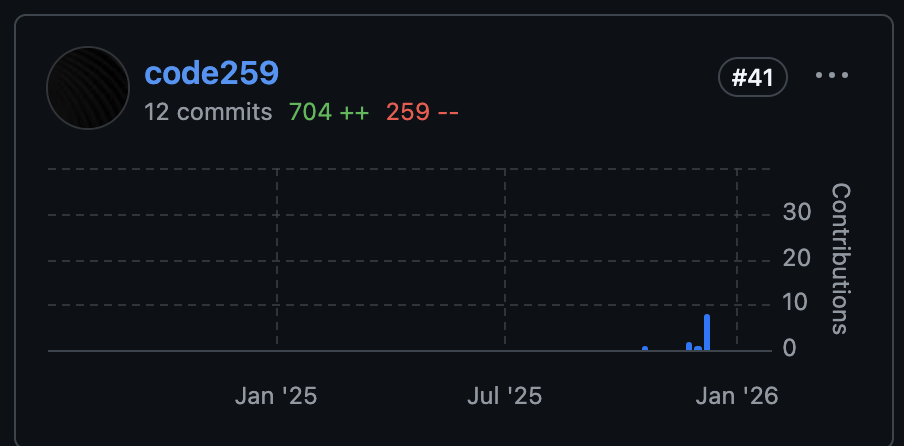
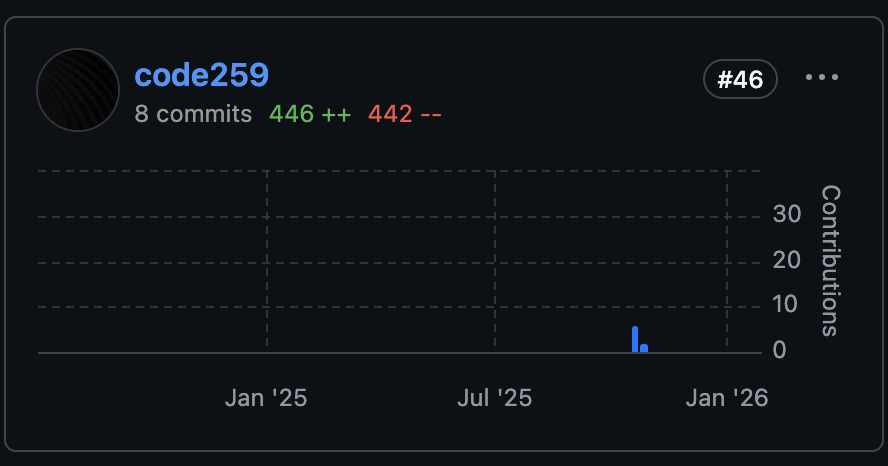
Commits
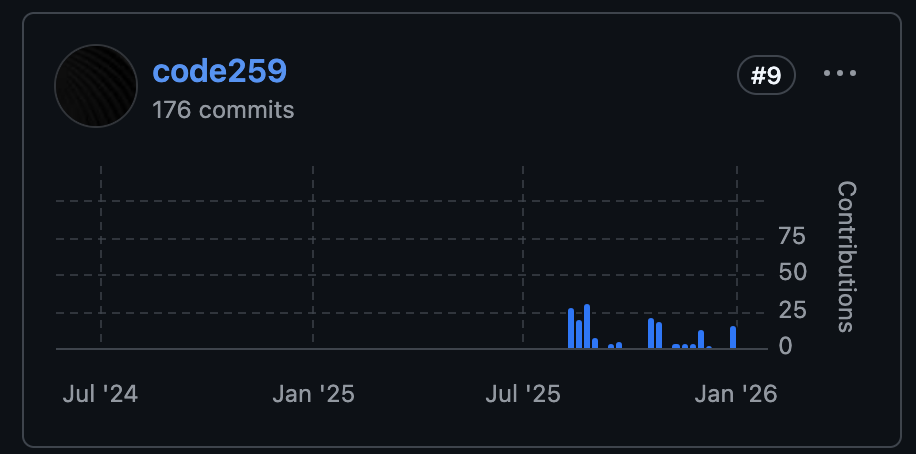
Note: Number 9 all time out of hundreds of contributors on pages
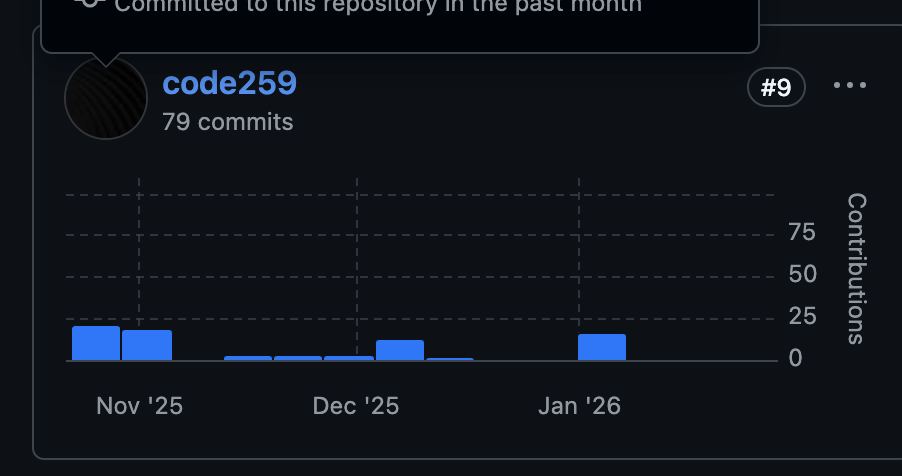
Note: Number 9 in last trimester of hundreds of contributors on pages
Note: Total 20+ spring commits across repos
Growth & Personal Development
Technical Skills
- Improved Java Knowledge (Backend):
- Learned to use Java with Spring Boot to build and manage backend APIs.
- Created POJOs, schemas, and database tables (e.g., user progress, grades).
- Understood Spring’s exception handling and Java’s static typing error patterns.
- Gained experience debugging backend logic and data flow between API and database.
- Improved understanding of REST structure and general backend design principles.
- Improved Frontend Knowledge (Frontend):
- Learned how to approach more modular frontend design, especially when working with others on shared layout and UI components for OCS.
- Gained experience using layouts more effectively to avoid repeating the same structure across multiple pages.
- Better understanding of the GitHub Pages toolset and how static site constraints affect design decisions.
- Learned how to handle larger frontend refactors without breaking existing pages by making incremental, testable changes.
- Improved skills in debugging frontend issues, including layout bugs, styling conflicts, and broken links.
- Became more comfortable tracing bugs across HTML, CSS/SCSS, and JavaScript instead of treating them as isolated problems.
Soft Skills
- Improved Agile/Scrum Skills:
- Gained deeper understanding of team-based Git workflows (forks, PRs, branching).
- Learned how to create clean, non-breaking PRs with readable, modular changes.
- Tested teammates’ PRs using
git checkout, ensuring functionality before merges. - Improved at code reviews by identifying logical errors, style issues, and better implementation approaches.
- Developed a stronger overall grasp of collaborative development and version control discipline.
- Communication:
- Learned how to communicate clearly in a larger team setting (12+ people), which required more structure and accountability.
- Improved at meeting deadlines as part of a large team by coordinating tasks and understanding dependencies between people’s work.
- Became more comfortable asking teammates for help or clarification when stuck, instead of blocking progress by working in isolation.
- Used tools like VS Code Live Share to collaborate in real time on debugging and implementation.
- Gained experience using Slack and other messaging platforms to share updates, ask questions, and resolve issues quickly.
- Improved at giving and receiving feedback in a constructive way, especially during PR reviews and planning discussions.
Future Direction
Option 1: Passion Project
Note: Still thinking about ideas and discussing with potential groupmates to identify and idea of interest
Option 2: OCS & Potential improvements/tasks
Frontend
- Redundancy: There is significant redundancy in the SCSS and CSS across the site. Many
.mdfiles and isolated pages have their own custom CSS written by different contributors, which leads to overlapping styles, duplicated rules, and general bloating. While there have been attempts at theming, the theme does not propagate cleanly across all pages, so the visual experience often feels inconsistent and fragmented. - Modularity: The frontend lacks strong modularity in its components. Common UI elements such as buttons, icons, dropdowns, cards, and layouts are frequently reimplemented instead of reused. This makes the design harder to maintain and causes inconsistencies in spacing, colors, and interactions.
- Consistent Style: Adopting a shared component or style library (similar to how Tailwind CSS encourages reusable components and utilities) could help enforce a consistent design language, reduce repeated work, and make it easier for contributors to follow a clear structure when building new pages.
Backend
- Data Capture: Data capture is limited across the platform. There is an opportunity to collect more meaningful analytics from FRQs, homework, and lessons, such as reading time, completion patterns, retries, and common error points. With the existing S3 API, file uploads and related metadata could also be integrated more tightly, allowing data capture beyond the current local file-based system. Given that S3 storage is relatively inexpensive, this approach is more scalable and realistic long-term.
- Communication: Communication tools are present but difficult to use effectively. While microblogs exist, they feel rudimentary and lack the ease of use, organization, and responsiveness found in tools like Slack. This makes collaboration and discussion less natural than it could be.
- Personalization: The platform lacks strong individualized learning support. While OCS is a powerful and useful tool, most content is broad and generalized rather than tailored to individual users. With better data capture, the system could adapt content, pacing, and practice to each student. This individualization could be informed by established learning frameworks, such as Merrill’s First Principles of Instruction, by identifying prior knowledge, emphasizing application over passive reading, providing targeted practice, and reinforcing integration through personalized feedback and follow-up activities.